In the intensely competitive arena of today's serious drifting, success is not merely exclusively a product of brute engine power or pilot aggression. Conversely, it has become a multifaceted engineering challenge which necessitates a scrupulous blend of picking a time-tested car, arming it with the correct competition hardware, and, most essentially, grasping its live performance on the circuit through sophisticated suspension tuning applications. This comprehensive handbook acts as your roadmap from the very first idea of a drift build through to the last telemetry-optimized tweaks that elevate a powerful vehicle into a repeatable champion. We will thoroughly explore the methodical process of car suspension tuning, demonstrating how a state-of-the-art vehicle dynamics tool like precise measurement hardware eradicates approximation and offers exceptional clarity into your chassis's real-world dynamics.
The bedrock of any successful competitive sliding vehicle is, undoubtedly, the platform itself. A select group of platforms have achieved legendary status within the global drifting community due to their built-in weight distribution, strong design, and the vast ecosystem of performance components available. Picking the right platform is the initial and most significant selection a driver will make. For instance, the BMW's E36 3 Series is universally acknowledged as one of the finest overall drift platforms of the modern era. Its excellent 50/50 weight distribution, coupled with a RWD configuration and extremely reliable inline-six powerplants, forms a chassis that is at once forgiving for novices and incredibly capable in the control of a expert competitor. The evolution of this concept, the BMW E46 platform, builds upon these qualities with a more sophisticated frame, wider track for improved confidence, and even more lock directly from the factory. A different formidable platform in the professional scene is the Chevrolet Corvette C6.
This muscle-derived performance car offers a distinctive combination of benefits to the sideways sport, featuring a lightweight aluminum chassis, a backwards-positioned drivetrain component that aids in an ideal front-to-rear mass ratio, and the immense low-end power of a big GM LS engine. This blend makes it an absolute weapon on track, able of starting and holding extended slides with apparently easy use of power. For drivers desiring exceptional bang-for-the-buck, the Nissan Z33 excels as a excellent example. It comes from the factory with a robust body structure, a competent original LSD, and the free-revving VQ series engine that delivers plenty of horsepower and torque for learning and moving up in the sport. Its follow-up, the 370Z model, offers additional improvements in structural rigidity, suspension design, and outright motor power, solidifying its place as a common pick among serious competitors. Additional historic platforms that merit consideration encompass the nimble unique Mazda FC RX-7, the ever-present Nissan S13, the V8-powered SN95 generation Mustang, the more recent BMW E90, and the compact yet surprisingly playful and forgiving Mazda Miata. Each of these cars offers a different palette of attributes, complexities, and possibilities, but they all have in common the basic ingredients necessary to become a competitive drift machine.
However, choosing the correct car is only the starting point. To release the true capability of every of these machines, significant upgrades to the steering and suspension systems are absolutely essential. This is where the realm of performance tuning components becomes vital view. The single most transformative modification for a serious competition vehicle is the fitting of a drift-spec drift angle kit. These sophisticated assemblies, such as those manufactured by performance brands like SLR Speed, are created to dramatically enhance the vehicle's available lock-to-lock rotation. A OEM street car is highly restricted in how far its steering tires can turn, a design limitation for on-road use. In drifting, conversely, extreme steering input is continuously necessary to manage and sustain a drift. An angle kit substitutes the factory uprights, rod ends, and often A-arms with pieces that enable the steered wheels to reach degrees of turn in excess of 70 or even 80 °, as opposed to a typical OEM setting of around 40 to 50 degs.
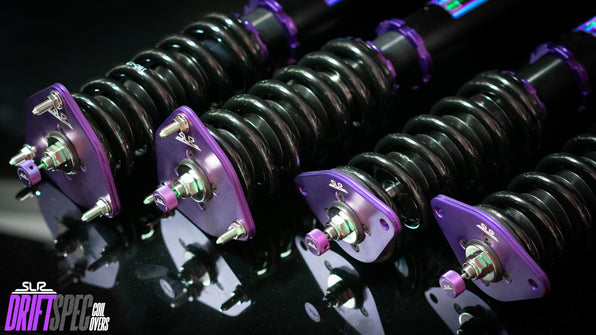
This immensely expanded steering angle provides the operator with exponentially greater control during a slide, enabling it to be considerably easier to start a drift, hold it through a long turn, and change smoothly from one side to the other. The contrast in drivability is nothing short of revolutionary. Coupled with a appropriately chosen modification is the just as vital upgrade to the car's suspension. Store-bought or including high-end sport coilovers are just not intended for the unique and brutal requirements of competitive oversteer. A dedicated pair of suspension units is paramount. These specific suspension components feature specific piston tuning and spring rates that are tuned for the extreme weight transfer that is characteristic of aggressive driving. When a driver begins a drift, the chassis's mass is shifted forcefully to the front of the corner. Correct drift-spec dampers manage this movement in a controllable fashion, allowing the car to settle rapidly and offering the pilot accurate feedback through the wheel and seat. They additionally provide precise tuning of ground clearance, rebound and compression stiffness, and weight balance, which are all integral elements of dialing in the vehicle's dynamics to a particular venue or piloting style. As a system, a precision-engineered drift angle kit and a expertly selected set of performance coilovers are the undeniable hardware base upon which all future optimization is based.
Once the fundamental parts is in place, the following critical stage in the build is the detailed setting of the car's alignment. This is the world of chassis dynamics adjustment, a procedure that can seem overwhelmingly complex to the newcomer but is, in reality, the defining factor to converting a collection of fast pieces into a unified and predictable machine. The most debated aspect of tuning for sliding is undoubtedly camber angle. Camber is the inclination of the tire compared to the upright plane when viewed from the front of the chassis. If the upper part of the wheel is tilted towards the chassis, this is referred to as camber-in. For drifting, negative camber on the steering wheels is generally used and is considered critical. The logic is intrinsically related to tire contact.
When a car is turning at extreme sideways angles, the chassis rolls to the outside of the turn. This body roll causes the outside front tire to diminish its best grip area with the asphalt. By applying vehicle dynamics tool inward lean, the wheel is pre-angled to counteract this lean. As the car tilts into the bend, the outside front tire gains a better contact patch with the asphalt, increasing its traction at the precise moment when it is needed most for steering authority. Commonly, front axle camber settings for a dedicated drift machine vary from approximately -3 degrees to as high as -5 degrees or even beyond, contingent on the specifics of the chassis setup, tire selection, and pilot style. The rear axle tires also use negative camber, but the settings are generally less and subtler than the front. Excessive negative camber at the rear can make the car overly loose and challenging to predict on acceleration application, as it diminishes the usable contact patch of the powered tires during linear acceleration. Thus, rear axle adjustments are often in the ballpark of -1 degree to -3 degrees, finding a precise compromise between providing sufficient lateral traction to help in starting and maintaining the angle while simultaneously preserving effective grip for acceleration the bend. Camber is just one component of the broader suspension geometry equation, which also involves toe angle, caster angle, and bump steer modification.
Toe setting describes the angle of the wheels when looked at from a bird's-eye view. Inward toe means the leading edges of the tires are closer together than the trailing edges, while outward toe means the opposite. For oversteer, a slight amount of front negative toe is frequently run to sharpen the turn-in directional response, making the vehicle feel more responsive and eager to start a oversteer moment. Rear axle toe is usually set to neutral or a incredibly slight amount of inward toe to foster stability under power. self-centering is the longitudinal or rearward angle of the kingpin axis when observed from the lateral of the vehicle. Increased positive caster improves self-centering and high-velocity solidity, and it also adds to negative camber increase during steering, which is very useful. Adjusting these settings is a detailed interplay where a modification to one parameter can and often will affect the other settings. The traditional approach for setting a car's alignment for competition has long been a time-consuming endeavor of trial and error. A pilot or engineering group would make a adjustment based on intuition, run the vehicle on track, rely on the pilot's subjective sensation and feedback, and then apply another tweak. This cycle would continue over and over until the chassis felt "good" or the allotted track period ran out. This system is not only exceptionally wasteful in terms of hours and tires, fuel, and parts, but it is also deeply imprecise.
Human feel is a famously unreliable measurement tool, colored by many variables such as fatigue, varying track grip levels, weather, and just the mindset of the driver on that given day. What feels "loose" on one lap might feel "tight" on the next pass, leading to contradictory data and counterproductive tweaks. This traditional limitation in car suspension tuning is specifically where contemporary technology has made its mark to completely change the process.
The development and integration of specialized suspension tuning applications has brought about a completely new era for engineering and optimizing professional sliding vehicles. These systems, showcased by cutting-edge solutions like GripDial, operate by actively capturing the actual mechanical performance of the vehicle as it is piloted on the track. Unlike depending on personal feel, these devices acquire measurable metrics on essential factors such as shock absorber movement, wheel speed, G-force loading, steering angle, and driver input position. This acquired telemetry is then processed by advanced algorithms that can visualize and interpret the information in a actionable format. For the first time, engineers and builders can visualize specifically what the car is performing at every point of a slide. This function changes the complete alignment optimization process. Imagine the particular challenge of optimizing the front camber for a specific chassis. Rather than applying a modification from -3 degrees to -3.5 degrees and then driving several runs to try and "sense" a improvement, a suspension tuning tool can deliver immediate and definitive information. The application can display in a chart how the wheel's loading is behaving during the critical moments of a angle: turn-in, holding the angle, and transition. It can show if the present angle is enabling the steering tire to achieve optimal grip or if the compound is over-stressed on its outside shoulder.
The software can after analysis suggest data-driven suggestions for adjustment. Perhaps the data shows that the tire is still overloading its outer shoulder at -3.5 degrees of camber, implying that a move towards angle, say -4 degrees, might be warranted. Alternatively, the information might indicate that the tread is not coming up to temperature or that the inner edge is degrading too quickly, which could indicate that there is excessive negative camber and a slight reduction back to -3.2 degrees would be more efficient. This degree of accuracy and actionable insight was completely impossible in the days of solely mechanical adjustment.
The benefit of using a advanced vehicle dynamics tool extends much further than just optimizing camber. It becomes an essential damper adjustment manual that is customized to your exact chassis. When setting the rebound and compression settings on your suspension, instead of relying on general tips or copying another car's settings, you can use the software to observe how the chassis is performing in response to your tweaks. The tool can show the damper movement trace over a lap, highlighting if the shocks are managing the weight transfer optimally or if they are causing the chassis to bounce uncontrollably after a flick. It can assist in diagnosing challenges like hitting the bump stops or losing droop, enabling you to introduce data-backed choices to spring preload, rebound/compression settings, or ride height. This approach translates equally to the detailed process of car alignment tuning. In addition to camber, the software can give insight into how adjustments to toe and caster angle are affecting the chassis's balance during different maneuvers of a drift. For instance, it can assist you to determine the best amount of front axle toe-out for your individual angle kit configuration and driving approach by analyzing the speed of turn-in response car alignment tuning and the stability of the vehicle at maximum steering angle. This transforms the software an extremely powerful performance optimization handbook that is actively updated by the live behavior of your specific vehicle on the track. It elevates the entire project from a mysterious craft into a repeatable optimization exercise.
Additionally, the utility of a tool like modern telemetry is not at all restricted to experienced engineers with large budgets. For the club-level enthusiast, it acts as an powerful equalizer. It effectively offers the driver with the insight of a expert dynamics engineer without the typical expense. It drastically shortens the development time by providing definitive solutions to problems that would otherwise take countless track days of experimentation to understand. A tuner can understand how their individual car behaves to various settings, developing a deeper comprehension of vehicle dynamics in the endeavor. It also makes accessible professional suspension engineering techniques, enabling anyone with the ambition to optimize their machine to achieve it in a structured and successful way. This is notably valuable in a sport like oversteer competition, where setup expertise has traditionally been a highly secretive asset among professional drivers. Now, that capability can be in the hands of any serious enthusiast.
In summary, the journey to engineering and tuning the perfect competitive drift machine is a comprehensive project that smoothly integrates time-honored mechanical wisdom with 21st-century digital tools. It begins with the wise pick of a capable chassis, then built upon the integration of non-negotiable drift-spec parts like high-performance drift angle kits and correctly valved competition coilovers. The journey then advances into the intricate realm of alignment optimization, where parameters like camber angle, toe setting, and caster are carefully adjusted to suit the car's new geometry and the operator's individual needs. Finally, and what genuinely differentiates the contemporary process from the past, is the adoption of a sophisticated vehicle dynamics tool. This platform eliminates the guesswork and waste of only feel-based tuning by delivering objective, live information on how the drift suspension tuning guide vehicle is actually functioning. It serves as an incredible engineering partner, a definitive coilover setup manual, and a all-in-one performance analyzer. As a complete package, this complete philosophy ensures that each and every component of the drift machine—from the choice of the car to the most minute click on the coilover—is refined for ultimate performance on the circuit. It embodies the full maturation of the discipline of oversteer driving, connecting raw pilot talent with precise suspension engineering to forge the perfect dominant cars attainable.